Introducing…
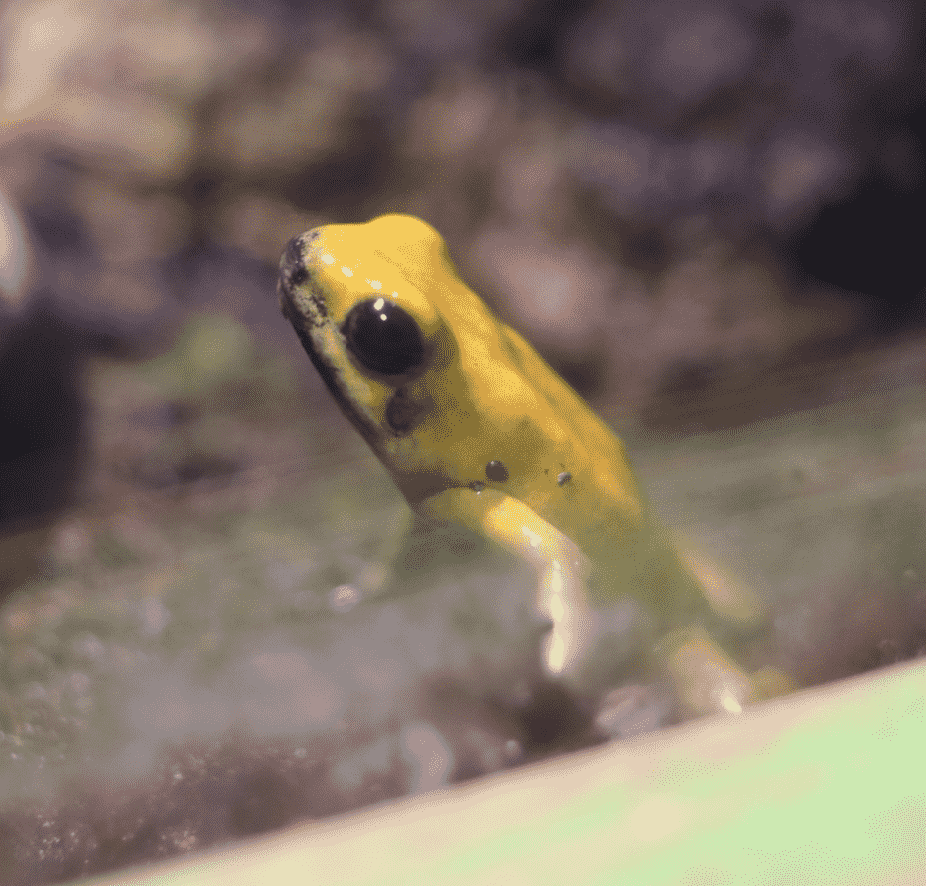
Cute as a button but deadly to boot – meet the black-legged poison dart frog.
Sure, the black-legged poison dart frog (Phyllobates bicolor) may be adorable at first sight but don’t underestimate this thumb-sized amphibian. This happy little hopper is the second-most toxic dart frog in the world, its skin loaded with enough poison to bring down a fully-grown human. Yikes!
Don’t let that deter you, though, because the black-legged dart frog’s toxicity is really reserved just for predators. Indeed, the threat of almost certain death coupled with the frog’s “stay back, I’m dangerous” colouring is enough to keep most would-be predators at bay.
Here’s everything you need to know about the black-legged poison dart frog ahead of your official meeting at Deep Sea World.
Habitat
Black-legged poison dart frogs are native to the rainforests of western Colombia, particularly the Chóco region. Like all other poison darts, the black-legged frog is a tropical amphibian, meaning it requires a precise level of humidity to survive and keep its skin moist.
Sadly, in the wild, black-legged poison dart frogs are now categorised as ‘endangered’ by the IUCN. That’s mainly due to habitat loss brought about by deforestation, cattle grazing, mining, and pollution.
Appearance
Well, for starters, their legs are black! As for the rest of them, they’re yellowy-green in colour, so the contrast is quite striking.
This distinctive colouring isn’t all about avoiding becoming a passing predator’s dinner, either. The vibrancy of the dart frog’s colouring typically dictates how easily an animal will find a mate and reproduce, and it’s very much the brighter the better where these frogs are concerned.
It’s worth pointing out, too, that the black-legged poison dart frog is one of the largest poison dart frog species, growing to an average size of 45-55mm.
Diet
Black-legged poison dart frogs sure like to eat. Moving across the forest floor in double-quick time thanks to their rapid-fire hops, these carnivorous dart frogs snack on everything from termites to beetles, using their long, sticky tongues to ensnare their prey.
As for predators, the poison dart frogs of South America are known to have only one natural nemesis, the fire-bellied snake (Erythrolamprus epinephalus). These snakes, part of the Colubridae family, are thought to be immune to the toxins of poison dart frogs, including the golden poison dart frog (Phyllobates terribilis) and its black-legged counterpart.
Did you know? The indigenous people of the Colombian rainforest have been known to extract the toxins of the black-legged dart frog for use in poison-tipped arrows for hunting.
Introducing…
Cute as a button but deadly to boot – meet the black-legged poison dart frog.

Type
Amphibians

Size
Up to 5.5cm long

What do they eat
Small insects such as ants and termites

Water type
Land

Where are we
Western Colombia
